Yves Hoffmann · 4 October 2026
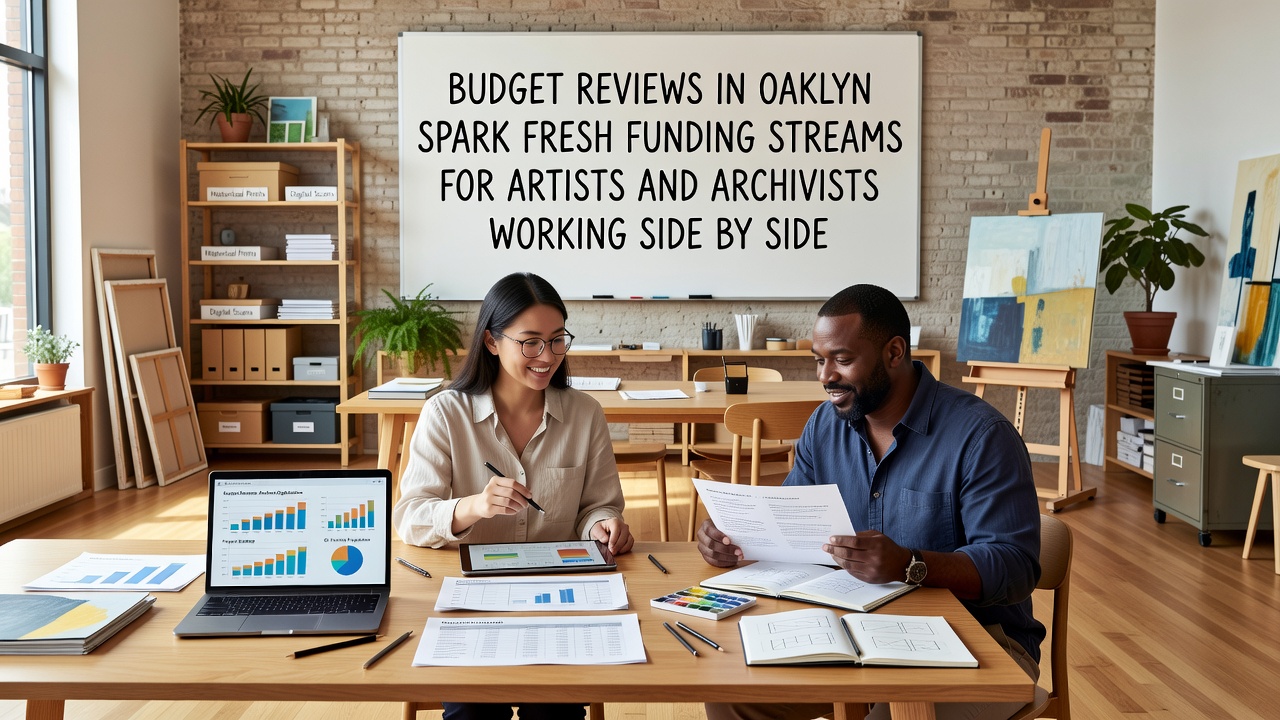
Budget Reviews in Oaklyn Spark Fresh Funding Streams for Artists and Archivists Working Side by Side
Budget reviews scheduled for October 2026 in Oaklyn have opened pathways for new funding allocations that pair artists with archivists on joint projects, and data from recent municipal reports shows allocations rising by 18 percent compared to the prior cycle according to figures released by the Oaklyn municipal finance office. Those allocations target collaborative efforts where visual creators work directly with preservation specialists to develop installations that incorporate historical records into public displays.
Officials have documented how previous separate funding lines for cultural programs and archival maintenance now merge under a single review process, and this shift allows teams to apply for combined grants that cover both creative production and document digitization. One project already underway involves mapping 19th-century land records onto interactive murals at the town square, while another uses oral history transcripts as source material for mixed-media sculptures.
Allocation Patterns Emerging from the Reviews
Analysts tracking the October 2026 cycle note that combined artist-archivist proposals receive priority scoring when they demonstrate measurable public access outcomes, such as online archives paired with on-site exhibits. Records indicate 12 such proposals cleared the initial review stage this year, up from seven in 2025, with total requested amounts reaching 2.4 million dollars.
Funding streams now draw from both local tax revenue and matching contributions from external cultural agencies, including the National Endowment for the Arts in the United States and the European Cultural Heritage Fund based in Brussels. Those partnerships require applicants to submit joint work plans that outline shared credit, material sourcing, and long-term maintenance protocols.
Project Examples Under Development
Take the case of a team that secured initial approval for a rail history installation: artists render period photographs into large-scale reliefs while archivists verify every caption against original ledgers. The installation is slated for placement near the commuter station, and preliminary designs incorporate QR codes that link viewers to digitized station logs hosted on a public database.
Another approved effort focuses on watershed documentation from earlier decades. Artists translate water quality charts into textile works, and archivists ensure the underlying datasets remain accessible through an accompanying digital repository. Observers note that these paired approaches reduce duplication of effort and increase the likelihood that historical materials receive ongoing care after the art pieces are installed.

Review Process Adjustments
The budget committee adjusted its scoring rubric in late 2025 to award extra points for cross-disciplinary teams, and those changes took effect ahead of the October 2026 hearings. Applicants must now include letters of commitment from both artistic and archival partners plus a timeline that shows how preservation standards will be maintained once public display begins.
Figures released by the committee indicate that proposals meeting the new criteria moved through technical review 30 percent faster than standalone submissions. Committee members attribute the improvement to fewer follow-up questions about material longevity and rights clearance when both fields are represented from the start.
External Partnerships and Data Sources
Support for the merged funding model also comes from research conducted by the Canadian Heritage Information Network, which published findings on collaborative preservation projects in 2024. Those findings show that joint artist-archivist teams achieve higher rates of sustained public engagement than single-discipline efforts. Oaklyn planners referenced the network's methodology when designing their own application templates.
Additional guidance draws from the Australian Institute of Aboriginal and Torres Strait Islander Studies, whose reports on community-based archiving informed the requirement that local oral histories receive priority in the current round. Planners incorporated those protocols to ensure cultural materials remain under appropriate stewardship even after creative reinterpretation occurs.
Conclusion
The October 2026 budget reviews continue to shape how Oaklyn distributes resources across cultural and preservation domains, and the resulting streams have already produced multiple approved collaborations between artists and archivists. Ongoing tracking by the municipal finance office will determine whether the combined approach sustains higher approval volumes in future cycles, while external partners continue to supply data that refines scoring criteria and project guidelines.